How to write a resume summary that makes recruiters stop scrolling
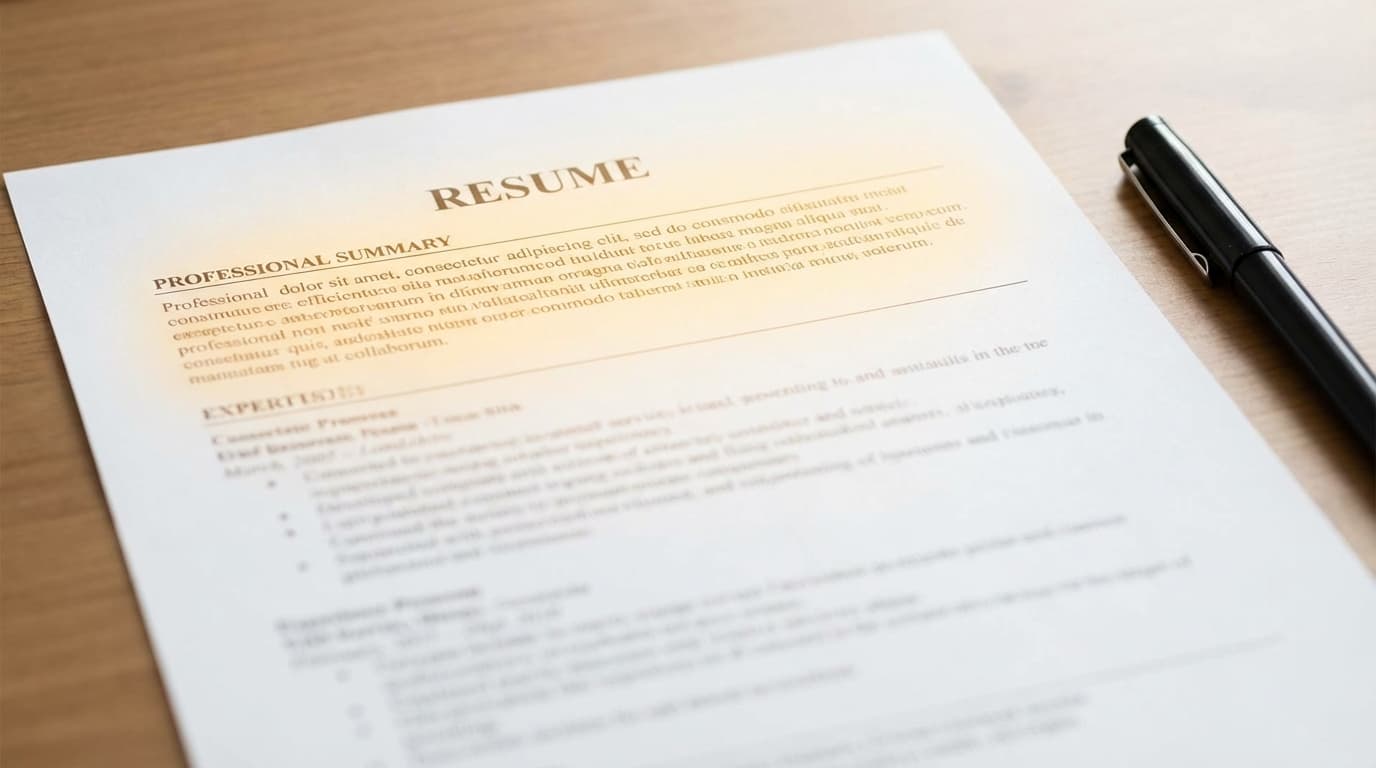
Six seconds. That's the average time a recruiter spends on the initial scan of your resume, according to a widely cited Ladders eye-tracking study. Your summary sits at the top of the page. It's the first block of text they read. If it doesn't grab them, the rest of your resume doesn't matter.
And yet most summaries are forgettable. "Results-driven professional with a proven track record of delivering results." That's filler. It could apply to anyone in any industry at any level. A recruiter reads it and learns nothing.
The formula that works
There's no one right way to write a summary, but the ones that work share three things:
They open with a specific identity, not a generic adjective. "Backend engineer who has shipped payment infrastructure processing $2B annually" tells you exactly who this person is. "Experienced software professional" does not.
They include at least one proof point. A number. A company name. A measurable result. Something that makes the claim verifiable rather than aspirational. "Increased paid conversion by 23% at Notion" is a proof point. "Passionate about growth" is not.
They end with direction. What are you looking for? Not in vague terms ("seeking new challenges") but specific ones ("looking for a senior IC role at a company building developer tools"). This helps the recruiter figure out if the role they're filling is actually what you want.
Real examples at different career stages
A strong summary looks different depending on where you are in your career. Here are three that work, and why.
Senior (8+ years)
Backend engineer who has shipped payment infrastructure handling $2B in annual transactions at Series B and C startups. Python and Go, with a track record of reducing API latency by 40% and cutting cloud costs by $180K/year through architecture redesigns. Looking for a senior role where systems thinking matters more than ticket velocity.
Career changer
RN turned healthcare operations strategist. Three years of ICU experience paired with an MBA focused on healthcare administration. Led a patient flow redesign at Mount Sinai that reduced ER wait times by 34%. Pursuing roles where clinical fluency meets operational decision-making.
New graduate
UC Berkeley data science graduate with published research in NLP applied to clinical trial matching. Built a seizure prediction model during a Stanford Health internship that outperformed the existing system by 12% on sensitivity. Looking for a role that bridges ML research and real-world healthcare impact.
Notice what all three have in common: a specific identity in the first sentence, a proof point with numbers in the second, and clear direction in the last. No "dynamic professional" anywhere.
Mistakes that kill your summary
Starting with an adjective instead of a noun. "Motivated marketing professional" puts the weakest word first. Lead with what you are ("Growth marketer who has scaled..."), not how you feel about yourself.
Writing it like a third person bio. Your summary should read like you're talking to someone, not like a Wikipedia entry. Drop the "Mr. Smith has over 10 years..." format. Just say what you've done.
Making it longer than 4 sentences. A summary is not a cover letter condensed into your resume. It's a hook. Get in, make your case, get out. If the recruiter wants more detail, that's what the rest of your resume is for.
Don't want to write it from scratch?
Our resume summary generator takes your job title, experience level, and key achievements, then writes a professional summary for you. It's free, instant, and designed to avoid every cliche on this list.
Treat the output as a strong first draft. Adjust the details, add anything specific to your situation, and make it yours. It'll get you 80% of the way there in about 10 seconds.
Should I use a resume summary or objective?
A summary. Objectives state what you want. Summaries state what you bring. Recruiters care about the second one. The only exception: if you are a brand new graduate with zero work experience, a brief objective explaining your target role can work, but even then a summary that highlights relevant coursework or projects is stronger.
How long should a resume summary be?
Two to four sentences, roughly 40 to 80 words. Any shorter and you are not saying enough. Any longer and you are losing the recruiter during their 6-second scan. If you cannot read your summary out loud in under 15 seconds, cut it.